
Essay
HS-ESSAY-2026-13
Case topology arranges opportunities; it does not create effects
Sections of this document
A case with four specialists can look richer than a case with one. It may also teach less.
Additional voices can surface genuinely different constraints. They can also create noise, encourage opinion shopping and let a learner outsource the decision about what matters. The educational question is therefore not how many personas a case can display. It is where responsibility for framing, seeking information, integrating evidence and handing off a problem should sit.
A case topology is the arrangement of roles, information and interaction that creates opportunities for particular reasoning moves. It is not a learning outcome. The arrangement can make a consultation choice or handoff visible; it cannot establish that the choice was sound, that the learner made it for the intended reason or that the judgment will recur without support.
This distinction prevents a design vocabulary from becoming a causal vocabulary. A topology can be named before it is tested. It earns an educational interpretation only through comparison with a relevant alternative and later independent performance.
Four generic arrangements of opportunity
Figure 1 shows four generic arrangements. They are analytic patterns rather than product features or evaluated treatments. Each moves control to a different place and therefore makes a different kind of learner work possible to observe.
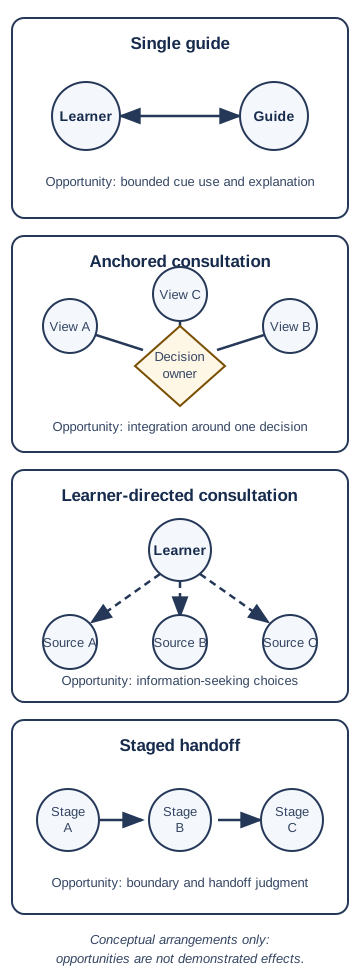
Table 1. Each arrangement makes one reasoning opportunity visible while leaving its quality unproven
| Generic arrangement | Where control sits | Reasoning opportunity | Evidence boundary and later test |
|---|---|---|---|
| Single guide | One learner and one bounded source share the case | Inspecting a worked judgment, explaining a cue or completing a missing step | Can become imitation or overguidance; a new case without the guide must test use and discrimination. |
| Anchored consultation | One decision owner retains the frame while several bounded perspectives enter | Integrating evidence and constraints around one accountable decision | The anchor can overframe the problem; a later task must change which perspective is decisive. |
| Learner-directed consultation | The learner chooses which information source to approach and when to stop | Information seeking, problem framing and consultation order | Performance can reflect interface familiarity or confidence; a later task should change labels while preserving evidence functions. |
| Staged handoff | Responsibility passes among role owners as the case changes stage | Temporal reasoning, boundary recognition and transfer of responsibility | A scripted sequence can substitute for judgment; a later case must remove the handoff cues and require justified transitions. |
Source and note: Authors’ conceptual classification, adapted from the mechanism and non-claim distinctions in HS-WP-2026-05. The rows are design hypotheses ordered by where control sits. They do not rank arrangements or report completed comparative results.
The evidence supports mechanisms inside the arrangements
The single-guide pattern has the closest adjacent evidence because worked examples have been studied directly. A mathematics meta-analysis reported a positive average, Hedges’ g = 0.48, 95% CI [0.36, 0.60], but extreme heterogeneity, I² = 93.72%, and a literature dominated by structured tasks and immediate accuracy (Barbieri et al., 2023). The result supports inspectable worked structure under conditions. It does not show that one humanlike guide is the best social arrangement.
Support also has to change with knowledge. Across 60 experiments, higher assistance favored learners with lower prior knowledge and lower assistance favored those with higher prior knowledge, but both estimates were highly heterogeneous (Tetzlaff et al., 2025). A small law experiment found worked cases useful for first- and third-year students alike. Topology cannot substitute for diagnosing what has become redundant on the focal task.
Evidence for several perspectives is narrower. In Hayashi’s laboratory rule-discovery experiments, a coherent dissenting perspective could prompt integration, while three dissenters were not better than one in the first experiment. The partners were scripted conversational agents, but there was no human, text or alternative-interface comparison; the immediate artificial task did not test retained professional judgment (Hayashi, 2018). The study supports task-relevant dissent under a constructive interaction climate. It does not validate an anchored or learner-directed topology.
Simulation evidence likewise supports rehearsal packages rather than a particular handoff structure. A synthesis of 145 higher-education studies reported favorable estimates for objectively assessed complex skills, including g = 0.63, 95% CI [0.38, 0.89], for role-play or standardized-patient formats, with I² = 87.02% and strong concentration in medical education (Chernikova et al., 2020). Practice, feedback and reflection were usually bundled. A separate direct comparison found no reliable overall advantage for trained standardized patients over peer role-play (Xiao & Fu, 2025). Realism can improve confidence or experience without improving objective performance.
The common lesson is that the instructional work occurs inside the arrangement: comparison, explanation, responsibility, feedback, calibrated support and a later criterion task. The topology allocates opportunities for that work. It does not perform the work for the learner.
Comparison, not multiplicity, carries the transfer claim
The strongest directly relevant higher-education transfer study held exposure constant. Eighty-eight management master’s students studied the same two negotiation cases. One condition explicitly compared them and derived their shared principle; the other analyzed each protagonist separately. One week later, 14 of 22 comparison-trained dyads (64%) used the target contingency contract, compared with 5 of 22 dyads (23%) in the other condition, χ²(1, N = 44) = 7.503, p < .01; no confidence interval was reported (Thompson, Gentner, & Loewenstein, 2000). Overall monetary gain differed by only 2% and not significantly.
That result is valuable because it identifies an activity rather than a surface format. Two cases were not enough. Learners had to align their structure and articulate a common strategy. The behavioral transfer was bounded to one negotiation task and did not produce a general economic advantage.
The implication for topology is precise. Holding an arrangement constant across an initial comparison can reduce irrelevant variation. Changing the arrangement on a later case can then test whether the learner acquired the decision structure or merely learned how to navigate one pattern. The claim belongs to guided comparison and aligned transfer, not to multiplicity itself.
What a comparative topology study would need
A credible study would hold the case content, relevant evidence, time, feedback and decision opportunity constant while varying only the arrangement of roles and information. Prior knowledge would be measured in the target domain rather than inferred from academic year. Outcomes would distinguish immediate assisted performance from a new unaided decision, delayed retention and a structurally aligned transfer case.
The observation model would matter too. An arrangement creates different opportunities: learner-directed consultation permits an information-seeking choice, while a fixed handoff may not. Missing behavior therefore cannot be interpreted without knowing whether the task made that behavior possible. Independent reviewers would need to judge the reasoning and decision, not merely count consultations, turns or roles.
Such a design could compare an arrangement with a simpler baseline and identify mediators: relevant information sought, constraints integrated, unwarranted certainty revised or handoffs justified. It could also test whether accessibility, disciplinary culture or prior experience changes who benefits. Until then, a topology remains a reasoned design hypothesis.
Where this evidence runs out
The limit of the evidence
No comparative study identified in the linked review establishes that one of these four arrangements produces better learning than another. No direct evidence shows that an AI expert cast, a larger cast, sequential consultation or staged handoff causes transfer. The adjacent evidence comes from worked examples, case comparison, laboratory dissent, simulations and role-play; each carries different populations, outcomes and conditions.
Case topology is still useful as a language of instructional responsibility. It forces clarity about who frames the problem, who selects information, who integrates perspectives and who recognizes that responsibility should move. Those choices can then be made visible and tested.
The topology is not the effect. It is the arrangement of opportunities through which comparison, feedback, responsibility and independent judgment may—or may not—become possible. Its scientific value begins when those opportunities are compared and the learner’s decision survives their removal.