Learning Pattern Insights
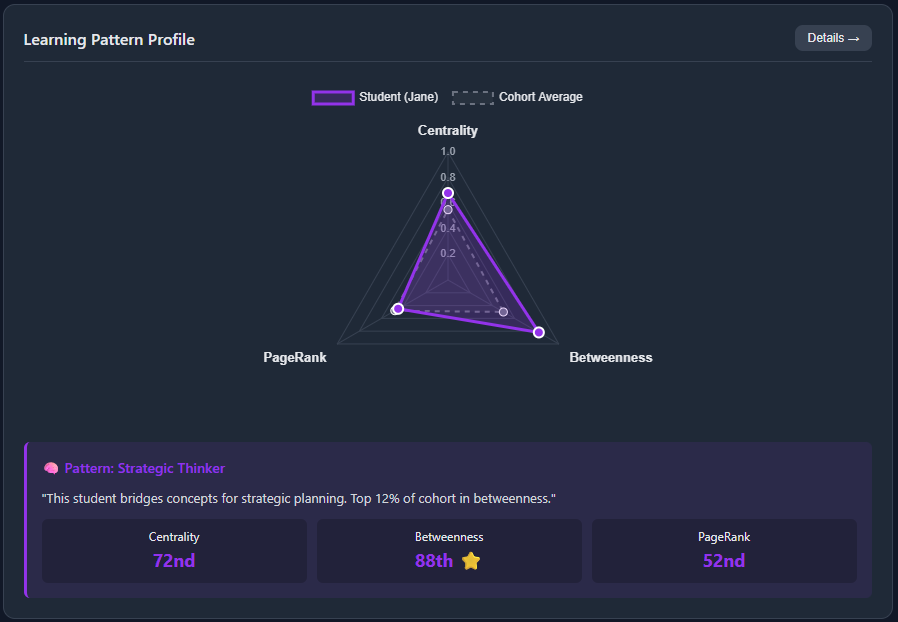
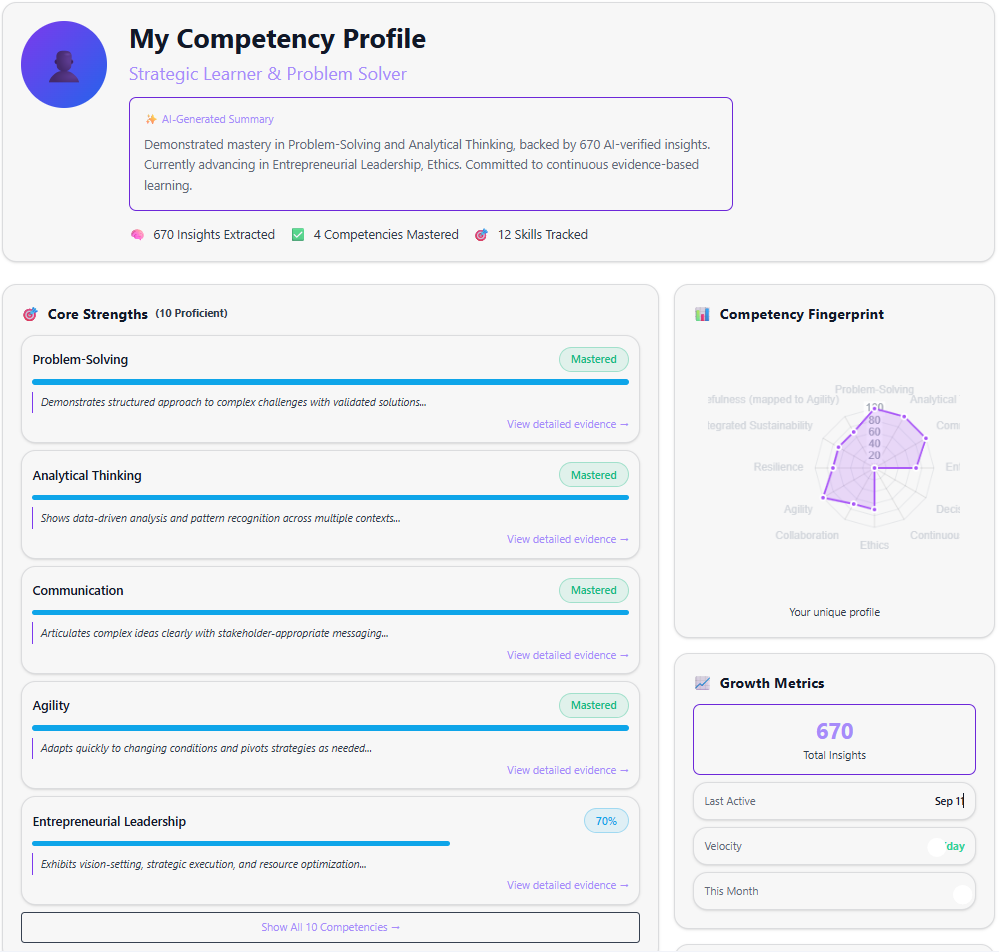
Visualize how students think using HeuriSight’s 10-category cognitive framework grounded in Cognitive Task Analysis (CTA). In dashboards, learning patterns are shown as a category profile (10-category distribution) with drill-down evidence.
Reveal reasoning styles
Surface how students approach decisions, not just the answers they reach.
Spot gaps early
See underdeveloped cognitive categories before performance declines.
Track growth
Monitor how patterns evolve after instruction and feedback.
How it works
Evidence-first interpretation
Each category signal can be traced back to underlying heuristics and student-attributed conversation evidence, preserving transparency and instructional trust.
CTA methodology
Captures decision strategies and the cues students use to solve problems, with traceable evidence.
10 cognitive categories
Maps heuristics into domains like problem-solving, risk assessment, and adaptation.
Descriptive topology summaries (optional)
Graph-metric archetypes (e.g., strategic thinker) are presented as descriptive-only summaries, not ground-truth cognitive style.
Where you see it
Inside the product
Signals and data sources
Socratic dialogue
Assessment conversations reveal reasoning steps and decision cues.
Heuristic graph
Extracted heuristics are categorized and scored for reliability.
Pattern aggregation
Signals roll up to student and cohort pattern summaries.
FAQ
Is this behavior or knowledge?
It focuses on reasoning behaviors: the strategies students use to solve problems.
How is CTA used?
CTA provides the method for capturing decision cues and mapping them to patterns.
How do patterns improve?
Repeated assessments strengthen confidence and reveal growth after instruction.
Outcomes
Scope & limits
Patterns strengthen with repeated assessments. Sparse dialogue results in lower-confidence insights.